Introduction
Field Effect's Network Sensors (available in a virtual or physical form) provide visibility into the activity occurring on your organization's network. By analyzing network traffic metadata, sensors help Field Effect MDR identify suspicious behavior, detect threats that may not be visible from endpoints alone. The vast majority of our deployments leverage virtual MDR SIEM sensors and physical network sensors for all locations that require network monitoring.
This article covers the following:
- Before you Begin
- Prepare the Monitoring Connection
- Deploy the Network Sensor
- Verify Connectivity and Traffic
- Troubleshooting
Before you Begin
Before deploying a Network Sensor, ensure that:
- You have access to the MDR Portal.
- Your organization has an active Field Effect MDR deployment.
- You have administrative access to your network infrastructure.
- You have a suitable location to deploy the sensor.
- Outbound internet connectivity is available for the Sensor.
- You can configure traffic mirroring on your network equipment, if required.
Prepare the Monitoring Connection
The sensor must receive a copy of network traffic from your infrastructure so it can be analyzed for malicious activity and other cybersecurity vulnerabilities. Common options to achieve this include:
- Switch SPAN or mirror port
- Network TAP
- Virtual switch port mirroring
- Cloud traffic mirroring solutions (where supported)
See our configuration guides to learn more. Also ensure that the proper firewall exceptions are in place so the sensor can properly communicate with Field Effect.
Deploy the Network Sensor
- Rack or place the sensor in the appropriate location.
- Connect the management interface.
- Connect the monitoring interface to the mirrored traffic source.
- Apply power to the sensor.
- Allow the Sensor to complete startup.
For more details, please see our documentation on Physical sensors.
Virtual Sensors are more advanced - please visit their documentation for more details on installation.
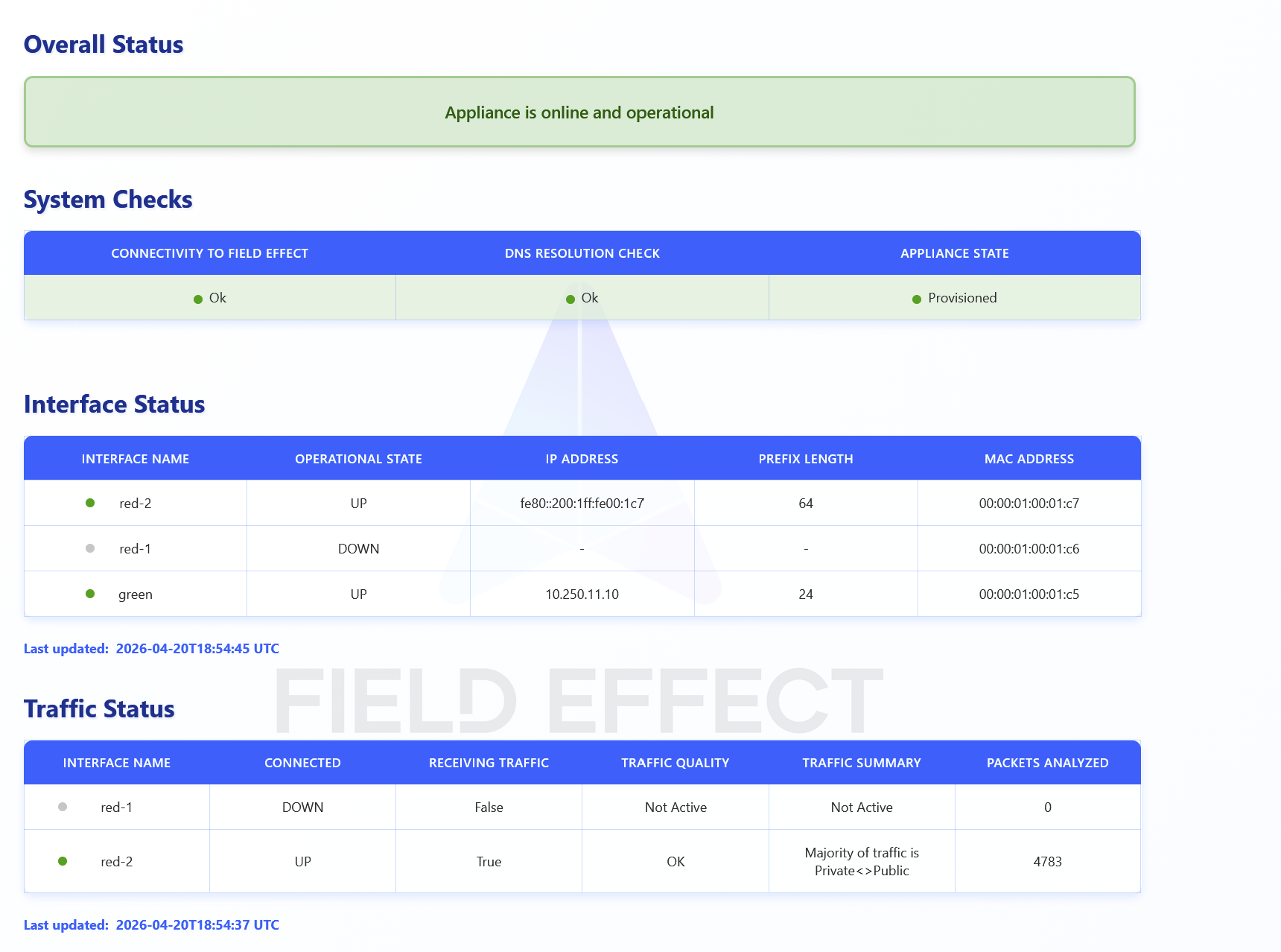
Verify Connectivity and Traffic
You can check the status of your sensor by navigating to its status page. To do so, navigate to the following in your browser:
https://<sensor's local_ip_address>/appliance_status/status/
This page is hosted locally on each network sensor, which means it can only be accessed from within the network. When trying to access this page, make sure that your device is connected to the same network as the sensor.
Troubleshooting
Sensor is offline
Verify that:
- The sensor has internet access.
- Required outbound connections are allowed through firewalls.
- DNS resolution is functioning correctly.
- The deployment package was installed correctly.
Sensor shows no traffic
Verify that:
- The SPAN, TAP, or mirror configuration is correct.
- Traffic is being mirrored to the proper interface.
- Network cables are connected correctly.
- The correct VLANs or interfaces are included in the mirror configuration.
Sensor does not appear in the MDR Portal
Verify that:
- Deployment completed successfully.
- The correct client deployment package was used.
- Network connectivity to Field Effect services is available.
Was this article helpful?
That’s Great!
Thank you for your feedback
Sorry! We couldn't be helpful
Thank you for your feedback
Feedback sent
We appreciate your effort and will try to fix the article